| |
 |
| |
Burgusio (in German: Burgeis,
from the Retoroman/Roman “Burgus”)
is Malles’ largest hamlet and can be
found at 1,216m above sea level in Val Venosta,
Alto Adige/South Tyrol. It lies at the foot
of Mount Watles (2,557m) where the river Adige
begins its course.
Its name comes from the Roman fort which
served as a security check along the “Claudia
Augusta” road which traverses the village.
The Counts of Burgus-Wanga, whose coat of
arms has been adopted by the village, probably
also owe their name to this fort.
Burgusio has 828 inhabitants (March 2007),
it lies 2.5km from Malles and is its largest
hamlet. Burgusio is twinned with Lohr Am Main,
Beilngries (Bavaria) and Weingarten (Wuerttemberg). |
 |
 |
|
| |
 |
 |
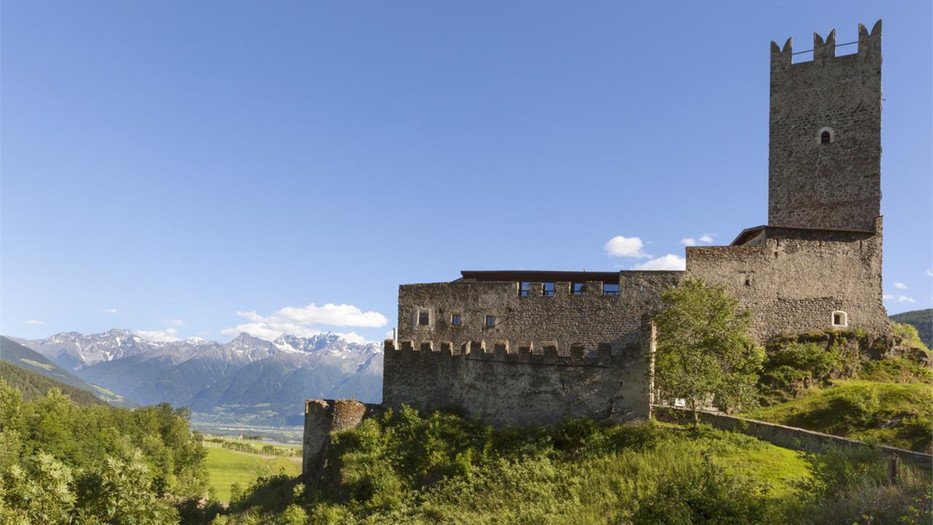
Castel Principe
Castel Principe was built between 1272 and
1282 by the Bishop of Coira, Konrad, and was
used as a refuge by Coira’s bishops. The
tower with its 3m-thick walls is a must to visit,
as is the Princes’ room and coffered ceiling.
|
|
| |
History of Burgusio
The name of the village name comes from the
Roman fort which served as a security check
along the “Claudia Augusta” road
which traverses the village. The Counts of Burgus-Wanga,
whose coat of arms has been adopted by the village,
probably also owe their name to this fort.
The village’s oldest records date to those
kept by the Benedictine monks between 1320 and
1395. In the twelfth century Burgusio consisted
of a number of farms dotted around the region
who had to pay taxes to both the Monte Maria
Abbey in Mustair and the Bishop of Coira who
was head of the diocese of Val Venosta. In those
times it seems there was also a convent dedicated
to Saint Zeno which probably stood where the
chapel is now. Goswin tells of a tower called
“Burgus” or “Castellin”,
situated between Castel Principe and the convent,
which brings to mind the name of the village.
|
 |
 |
|
| |
 |
 |
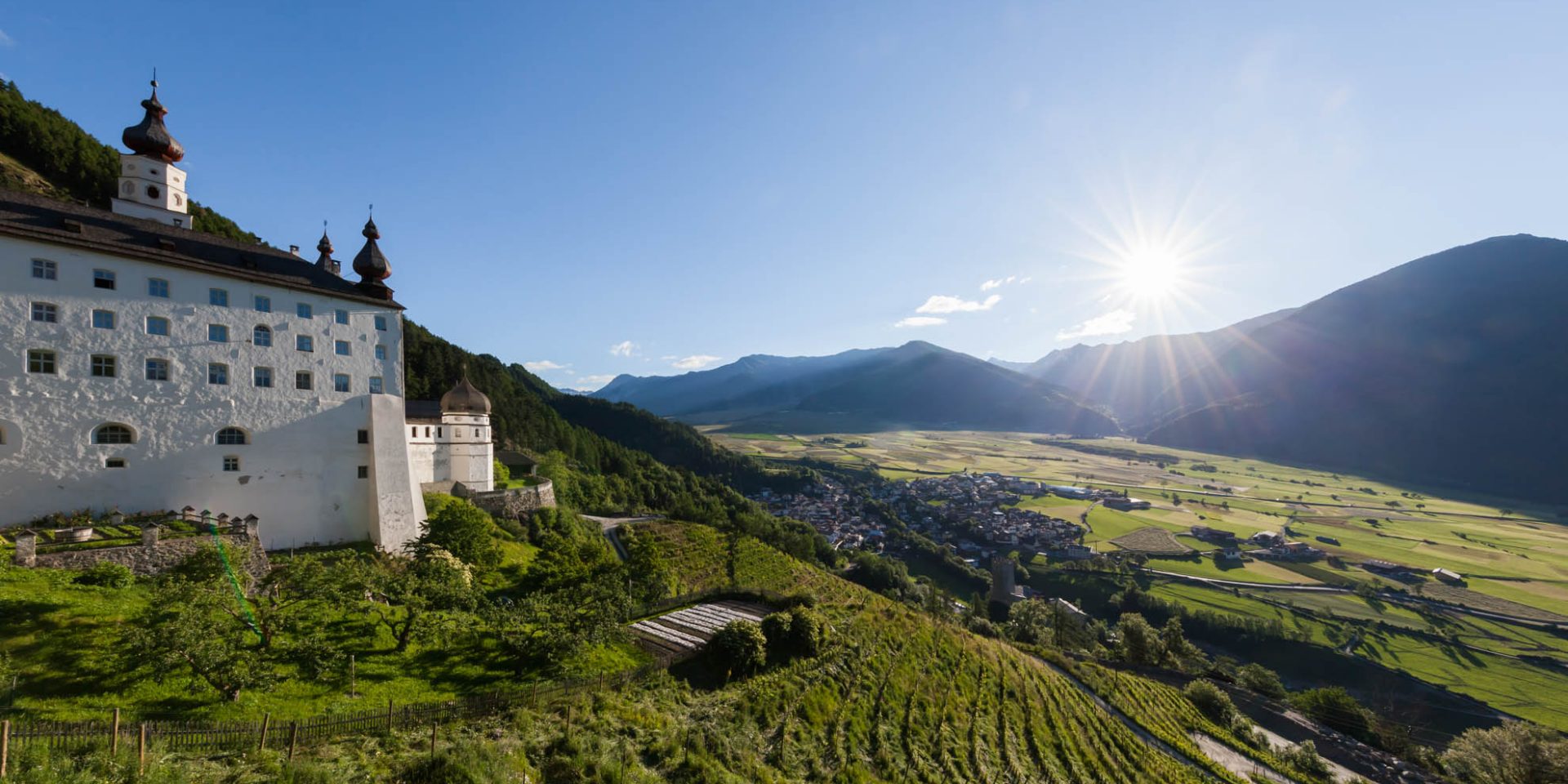
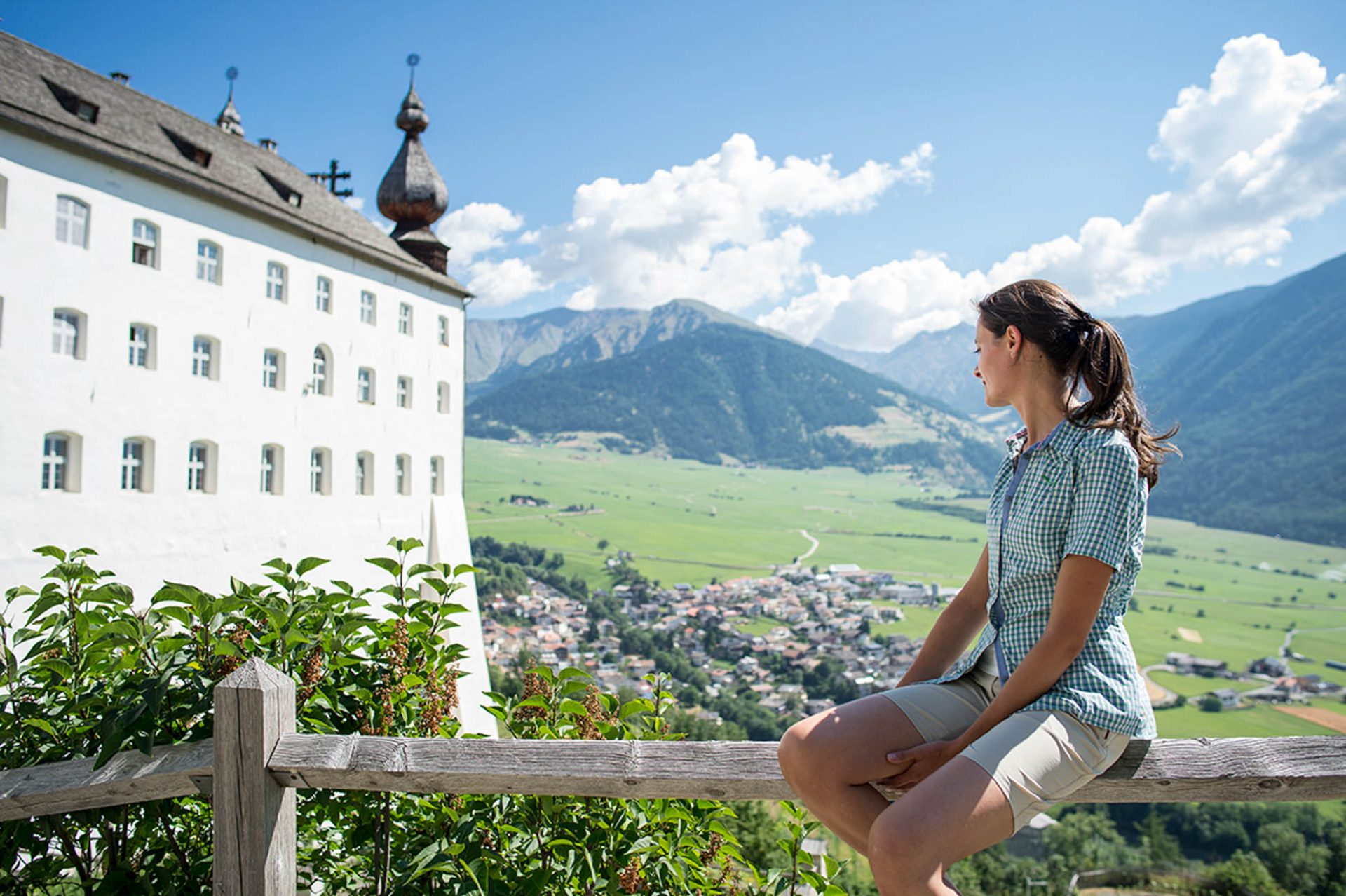
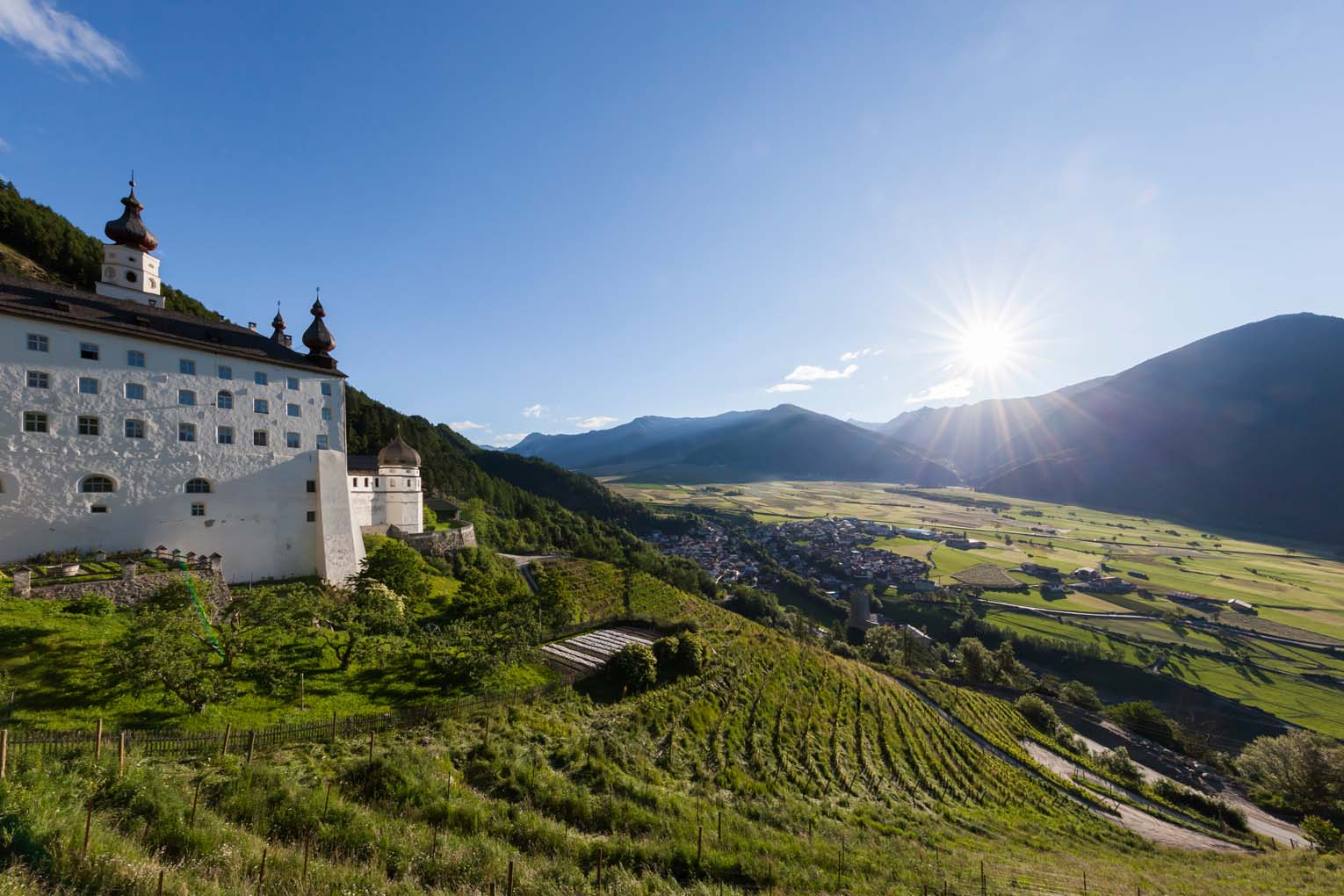
Monte Maria Abbey
The abbey was built in the twelfth century
AD by a group of noblemen from Tarasp. It became
a very important spiritual centre for the whole
of upper Val Venosta, as it still is today.
For a large part of the population of the area,
Monte Maria Abbey was the centre of religion,
culture and commerce. The abbey’s crypt
was consecrated in 1160 by the Bishop of Coira,
Adalgott, and was the first place of worship
by means of choral prayer and Holy Mass in the
area. The frescoes in the crypt are some of
the most significant Roman works of art in the
Alpine area. On the ground floor of the Abbey’s
former commercial edifice there is now a museum
which opened in 2007. Visitors to this museum
can get a glimpse of daily life behind the convent
walls. Some works of art have been displayed
in the museum for the very first time, and they
recall events which took place over the course
of more than 900 years. To mark the 200th anniversary
of the Tyrolean rebellion against the Franco-Bavarian
forces in 1809, the museum also displays two
letters written by the Tyrolean hero Andreas
Hofer to the abbey, as well as pieces of silk
from his flag. The letters were discovered not
long ago in the abbey’s archives.
|
|
| |
Santo Stefano
The church of Santo Stefano, situated near
the Monte Maria Abbey, dates from the fifth
century AD, although recent archaeological excavations
have brought to light prehistoric findings at
this site. It probably assumed the appearance
it has today in the ninth or tenth century AD,
as the type of lightshade hanging from the arches,
the triangularly-shaped place for the choir
and the triumphal arch testify. The perimeter
wall is 1.5m thick. On the wall behind the choir,
which is partly covered by the altar, there
are frescoes which date from 1498 representing
the coronation of Mary and the saints Stefanus
and Laurentius. Around the window there is a
painted decoration in the form of a climbing
plant. The table of the altar dates from 1677;
the sculptures from the church gable as well
as the statues on either side dating from ca.1500
AD have been moved to Monte Maria Abbey in case
of theft.
|
 |
 |
|
| |
 |
 |
Lake Pfaffen
You can get to Lake Pfaffen by chairlift or
on foot, first to mount Watles above Burgusio
and then there is a nice path to follow. It
takes about half an hour on foot from the Plantapatsch
refuge to Lake Pfaffen and the walk offers splendid
views of upper Val Venosta. The path then continues
up to the cross of mount Watles. |
|
| |
Prati Organ
In the centre of Burgusio stands the parish
church of the Sacred Conception, in which can
be found a Baroque organ built by Carlo Prati
between 1677 and 1678. This organ was originally
built for the Monte Maria Abbey but after the
convent closed in 1807 the Prati organ was sold
at auction by Burgusio village council and remounted
in the parish church. In 1874 Josef Aigner undertook
restoration works on the organ, using Prati’s
pipes for the facade and the very well-functioning
organ case on which can be seen the date 1678
and the abbey’s coat of arms as well as
that of Abbott Franz von Pasch.
|
 |
 |
|
| |
|
| |
|
| |
|
 |
|